Case study
Foundation load testing for a landmark bridge crossing the River Danube
Location
Mohács, Hungary
Client
Strabag
Project start and end date
March 2025 - December 2025
The Mohács Bridge is a major new infrastructure investment by Hungary’s Ministry for Transport and Public Works to strengthen connectivity across southern Hungary and enhance the efficiency of regional transport networks. Spanning the Danube with a modern steel design, the bridge has been engineered to accommodate increasing traffic demands while ensuring its long-term safety and durability. To help verify the foundation design, we provided full load testing services, giving clear insights on foundation load capability and optimising the pile design to support reliable and efficient construction. Beyond building transport connectivity, the bridge is expected to stimulate economic growth, improve access to key logistics and commercial corridors, and serve as a prominent landmark that supports the long-term development of the region.
Planning, feasibility, conceptual design
Design
Construction
Operations and maintenance
Decommissioning
Show full process
Solving foundation testing constraints
The Mohács Bridge has an optimised span that uses less material than traditional bridge design, bolstering the structure at its most vulnerable points whilst retaining its strength and mitigating wind and weather impact. This configuration minimises environmental impact on the river and surrounding ecosystem, reflecting a careful balance between infrastructure development and sustainability. Working closely with our client, leading European construction group Strabag, we implemented a comprehensive testing programme to support the bridge’s innovative design and development plans.
Load testing is vital to ensure the structural integrity of any major infrastructure build foundations. This is typically done by installing a test pile on site and testing the foundation’s behaviour under different stress loads. The cornerstone of our testing programme was our Osterberg cell® (O‑Cell®) bi‑directional static load testing system. This full‑scale test enables the safe application of high load levels from within the test pile, providing high‑resolution data and removing the need for large reaction frames, typically used to push hydraulic force down onto the test pile to measure its load capacity.
Our approach combined O‑Cell® with thermal integrity profiling (TIP), which offered continuous assessment of pile geometry and concrete quality. This bespoke solution reduced overall carbon emissions and unlocked significant programme and cost efficiencies for the project.
A practical solution for a complex river environment
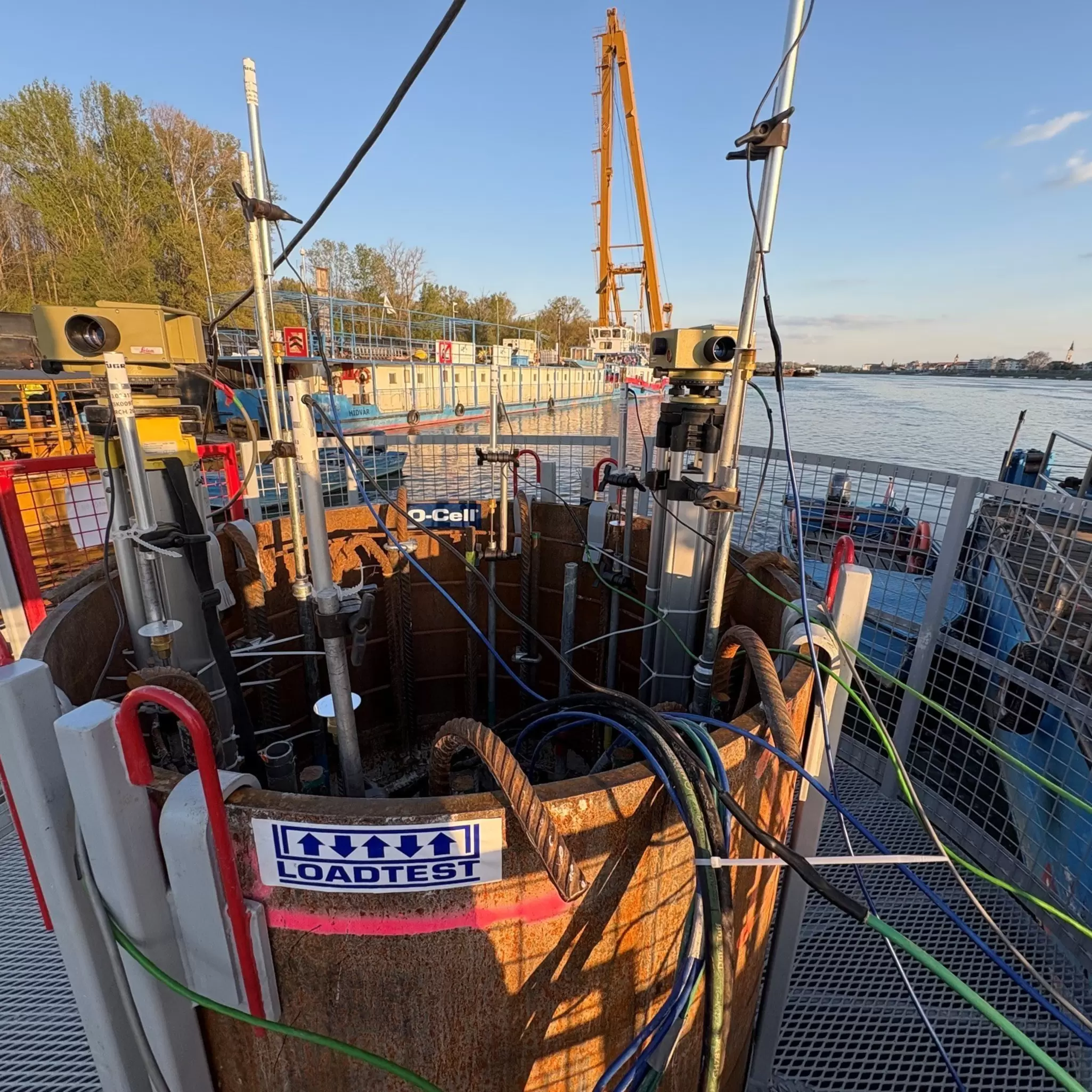
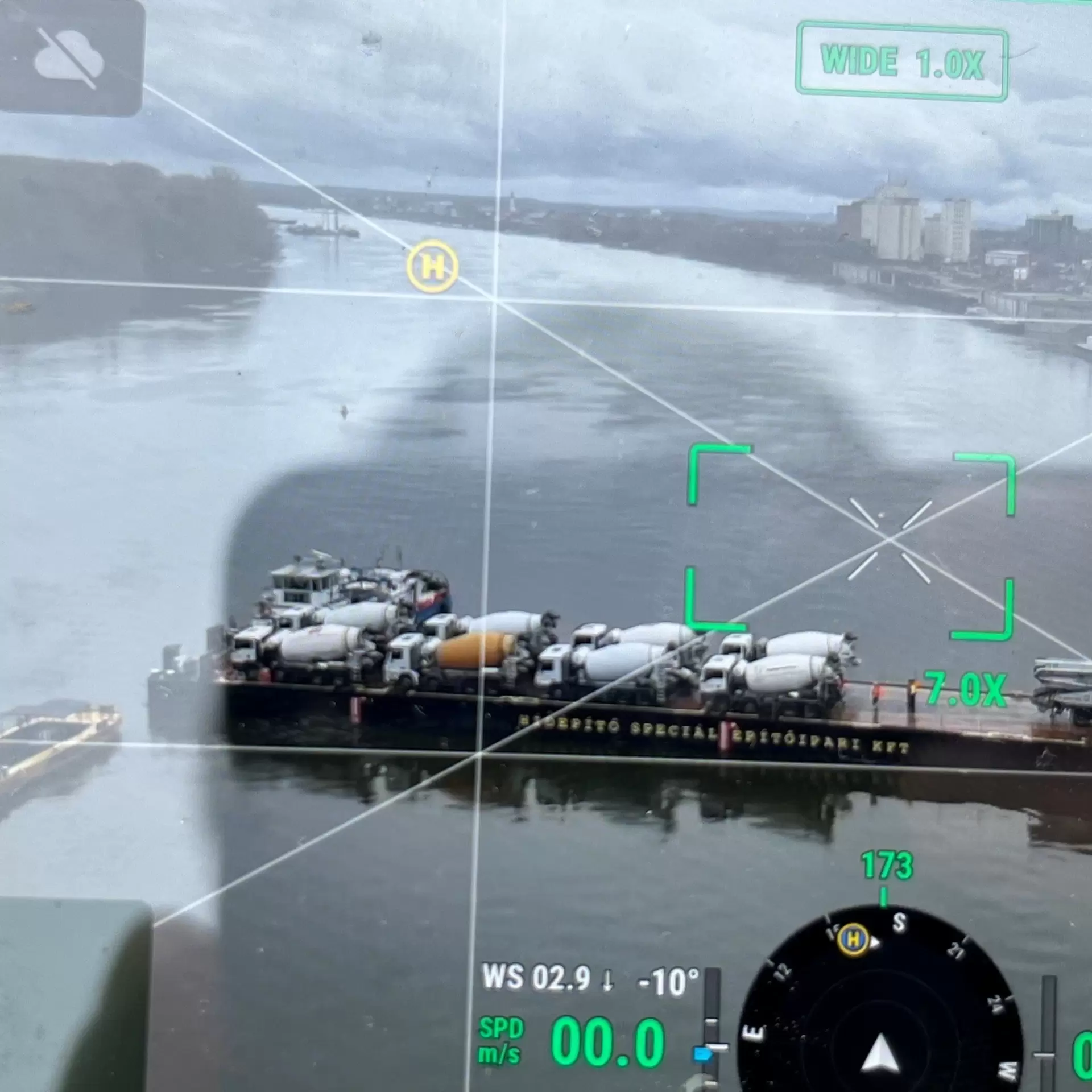
The project’s main contractor, Duna Aszfalt, established a floating construction site in the middle of the Danube where we could assemble an O-Cell® test pile and carry out load testing on the pile before construction of the bridge foundation began.
Working in the middle of a river, the team faced several constraints: restricted access, the need to install temporary platforms, variable water levels, and no land‑based reaction test options. These conditions required a solution that could operate safely and efficiently in a unique inland water environment.
Traditional static load testing was impractical and installing anchor piles or positioning a conventional reaction frame was impossible offshore. Attempting to fit a large reaction system into a temporary structure would have significantly increased operational risk for personnel and would have driven the project costs up significantly.
Bi‑directional load testing offered a simpler, safer approach because the reaction is generated within the pile itself, removing the need for an external reaction system, an essential advantage when working over water. This method streamlined operations, ensured high quality data capture would still be possible, and meant we could maintain robust health and safety standards.
1 / 2
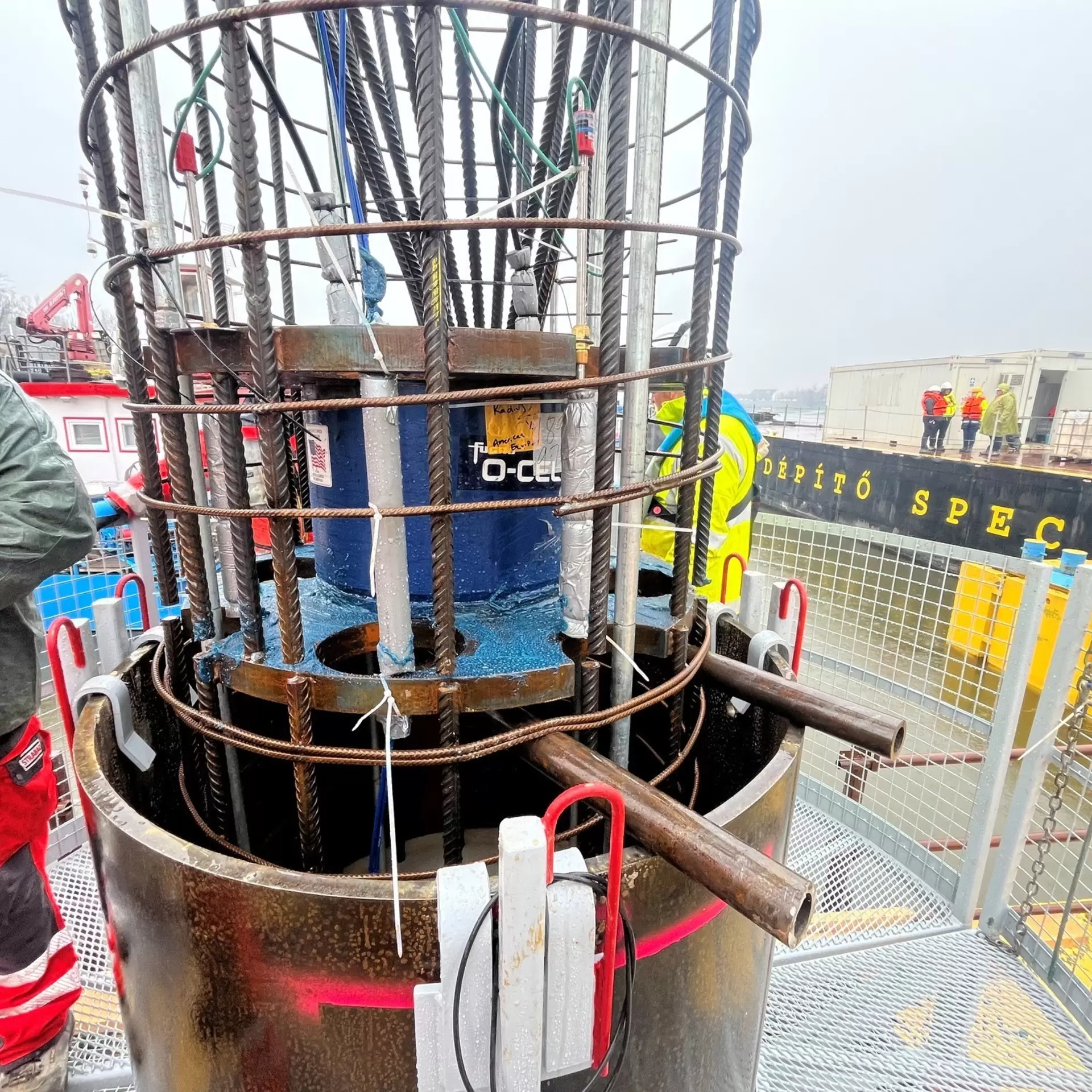
O-Cell® test pile used for load testing prior to bridge construction
Applying O-Cell® testing
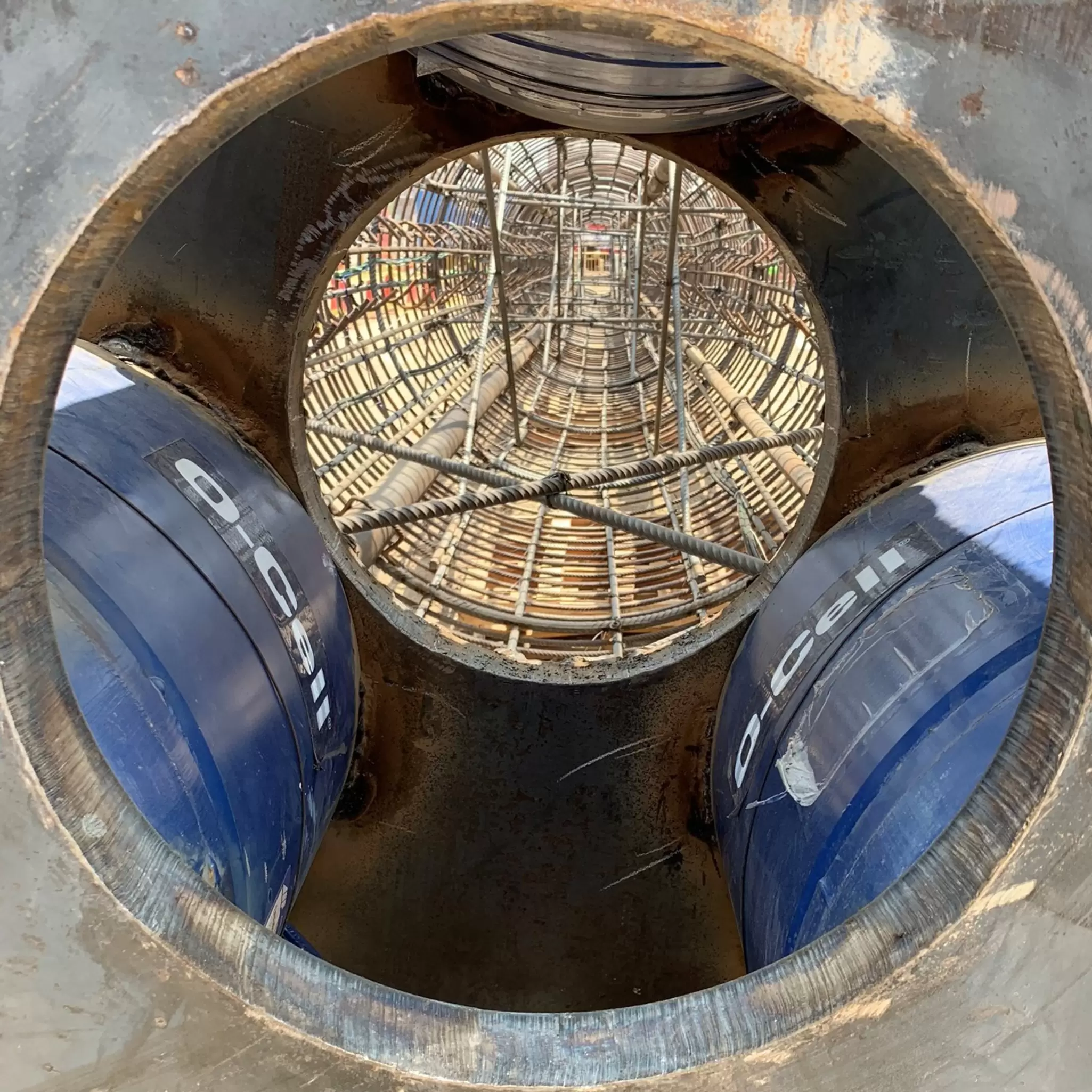
As pioneers of O-Cell® testing services worldwide, our Loadtest® team understood how to apply this technology effectively at such a complex site. As part of the test, one or more hydraulic cell(s) are inserted in the test pile and set within the concrete. Then, different pressurised elements can be assessed including the reaction of the cell itself, soil resistance, movement, strain, and load distribution in the foundation.
Unrestricted by the marine environment or changing water levels, the O-Cell® load test was able to verify high capacity foundation requirements. Test loads of 3MN to 300MN+, could be applied safely within the foundation element. With no reaction system at ground level, energy is safely buried well below the ground.
Thermal integrity profiling gives a fuller picture
Alongside the O‑Cell® load test, we carried out thermal integrity profiling (TIP), to add another layer of data insight to the foundation’s load-bearing performance and as-built condition. TIP is a non-destructive quality assurance tool used to evaluate the pile geometry, concrete quality and integrity throughout the full length of the test pile.
During construction, thermal sensors are installed within the pile reinforcement cage. As the concrete cures, the heat generated by the hydration process is monitored along the shaft. Intact concrete produces a predictable thermal response so variations in the recorded temperature profile can be used to identify changes in its composition, quality or potential defects.
The TIP data is used to assess the actual pile diameters and develop an accurate representation of the pile’s as-built shape. These diameter measurements are then incorporated into the O‑Cell® load test analysis, ensuring that the assessment accurately reflects the actual foundation.
By combining TIP with O‑Cell® testing, the project team gained greater confidence in both the structural integrity and load-carrying performance of the test pile. The integrated approach confirmed the quality of the in-place concrete and provided a robust evaluation of foundation strength, behaviour and reliability under the load of the constructed bridge.
Foundation confidence even in challenging conditions
For Strabag, the integrated testing programme provided confidence where it mattered most: confirming the foundation design before major construction began. Operating from a floating platform in the middle of the Danube, our Loadtest® team combined O‑Cell® bi-directional load testing with TIP to deliver clear, reliable insight into pile integrity and load-bearing performance. This data-rich solution supported efficient planning and allowed the project team to move forward with greater certainty in a challenging river environment.
total bridge length
full scale static load test offshore
deepest pile length from above water level to base
Efficient designs, reduced risk, and confidence in construction with
Foundation testing and design optimisation
High-precision, safe, and efficient foundation testing services and monitoring solutions for new construction and remediation projects, onshore and offshore. Find out more about how we can future-proof the foundations of your development.