Case study
GroundIQ® in action: Ruling out hidden ground risks for a hyperscale data centre
Client
Confidential
Solution
GroundIQ®
As part of our GroundIQ® solution, we performed 3D ambient noise tomography (ANT) to map subsurface conditions at a site planned for a major data centre campus, providing a more complete understanding of ground conditions to support confident design and risk management decisions.
Planning, feasibility, conceptual design
Design
Construction
Operations and maintenance
Decommissioning
Show full process
Introduction
As demand for digital infrastructure accelerates, data centres are being developed at an unprecedented scale and pace. For these assets, understanding ground conditions is critical: foundation performance and long-term structural stability all depend on a clear and reliable understanding of the subsurface from the earliest stages of development.
Our client was undertaking the development of a large data centre campus on a greenfield site located in a region shaped by historical underground mining activity.
We carried out comprehensive ground characterisation at the site. In addition to conventional investigation methods, we incorporated ANT into this as part of the bespoke GroundIQ® solution to deliver a high-resolution subsurface investigation relating to near surface layering, bedrock profile and in situ stiffness characteristics (as a function of shear wave velocity).
Challenges
Developing a large data centre campus requires confidence in ground conditions across the entire site, not just at isolated locations. At the site, a combination of historical land use, variable subsurface conditions, and the areal scale of the proposed development made it essential to reduce uncertainty and build a reliable picture of what lay below the surface.
1. Constraints from active construction
The site was actively under construction, with ongoing excavation work and frequent truck movements. These conditions limited the ability to carry out conventional ground investigation, as stopping construction for testing was not feasible. Understanding ground conditions under these operational constraints added another layer of complexity to early-stage planning and risk management.
2. Legacy mining and ground risk uncertainty
The site is located in an area with a history of underground mining. Even where mining activity is no longer present, past structures can introduce hidden ground risks, such as exploration tunnels that can induce localised collapse or subsidence. For a high-value, long-term asset like a data centre, these uncertainties needed to be carefully understood and managed.
3. Varied ground conditions
Information from boreholes showed that ground conditions change across the site. Near the surface, softer soils of varying thickness were present, underlain by bedrock made up mainly of shale with occasional sandstone layers. This variability made it difficult to assume uniform ground conditions across the site, increasing uncertainty for foundation design and construction planning.
4. Gaps between investigation points
Traditional ground investigation methods such as boreholes and cone penetration tests (CPTs) provide detailed information, but only at specific one-dimensional locations. For a site of this size, relying solely on these point measurements can leave large areas between investigation points open to interpretation and uncertainty. This can make it harder to robustly identify lateral and vertical changes in ground conditions and confidently map the shape and depth of the bedrock profile across the site.
Solution
Given the unique challenges of the site, we deployed GroundIQ®, our end-to-end ground intelligence solution, to provide a more complete understanding of ground conditions. Initially, our team used ANT to build a continuous, three-dimensional model representation of ground conditions (in terms of shear wave velocity) across the site. Using ambient noise, ANT provided direct insight into ground conditions between boreholes and CPT locations, reducing reliance on interpolation.
The ANT results were then combined with existing geotechnical data to create a single, integrated subsurface model. This made it possible to map changes in ground conditions and bedrock depth across the site with greater confidence rather than relying only on isolated investigation points.
By filling in the gaps between conventional ground investigation data, the 3D subsurface model provides a clearer and more reliable basis for understanding ground conditions across the proposed data centre campus, supporting better-informed design and planning decisions.
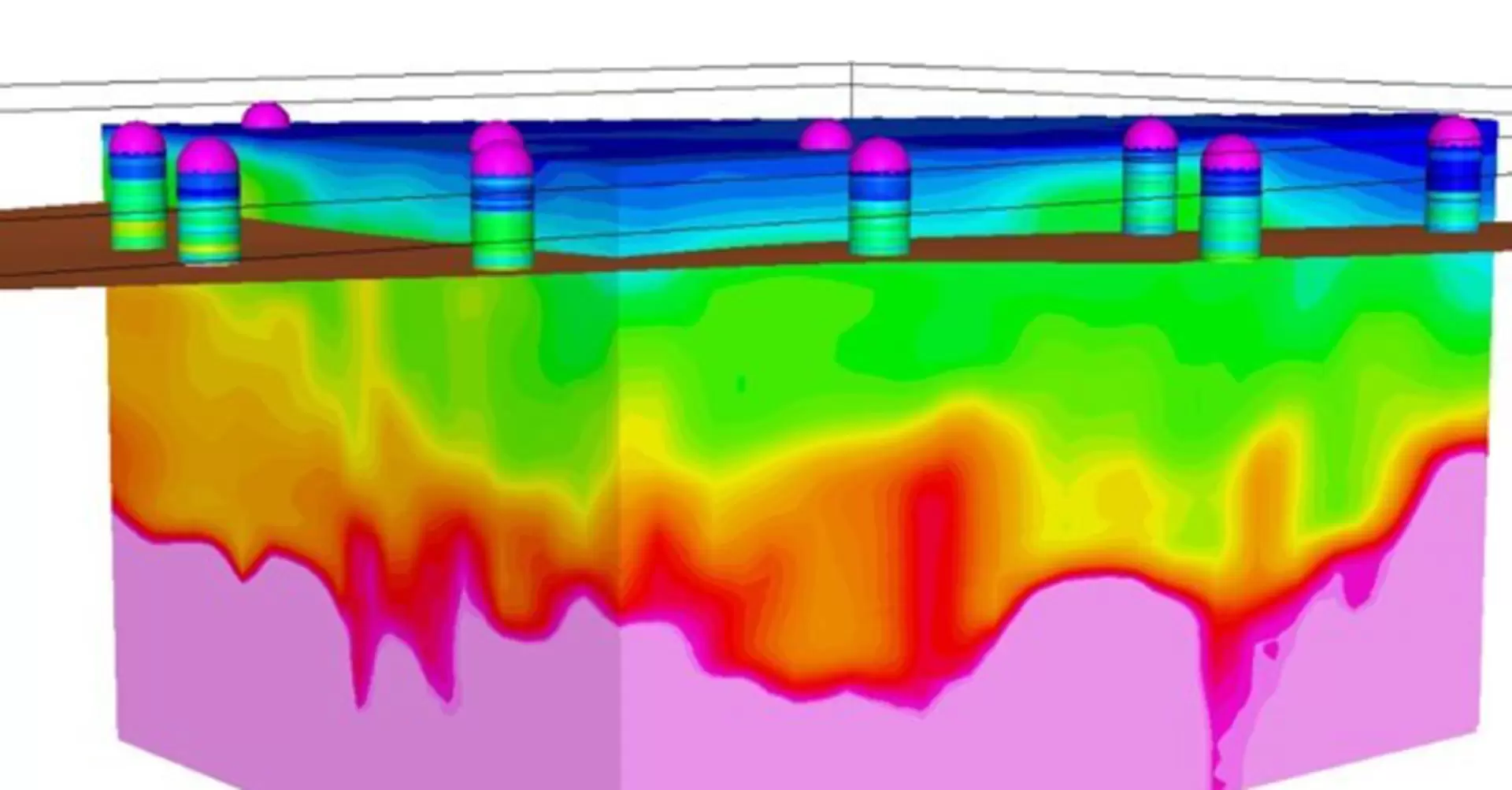
Integrated subsurface model combining geophysical data with CPT measurements
GroundIQ® approach
Utilising ANT as a vital tool within GroundIQ®, we deployed a dense array of seismic sensors across the site to capture both ambient and active source surface wave energy. The purpose of incorporating both ambient and active source energy into our survey strategy was to achieve the twin objective of high resolution (high frequency) information in the very near surface and deep investigation (low frequency) data. This non-intrusive setup allowed data to be collected efficiently across the site without disrupting activities or requiring additional intrusive investigation methods.
The recorded signals were processed to generate a three-dimensional shear wave velocity (Vs) model of the subsurface. Shear wave velocity is a key indicator of ground stiffness (G= density * Vs2) and, by mapping spatial variations in stiffness, the subsurface can be characterised in terms of areas of risk, layering, and bedrock depth. Data analysis techniques were used to group areas with similar subsurface characteristics, supporting the definition of geological layers and lateral variation.
To increase confidence in the results, the ANT-derived model was correlated with existing borehole and CPT data. This integration ensured the geophysical interpretation was consistent with measured site data, resulting in a validated 3D ground model that combined the strengths of both geophysical and geotechnical information.
Results
The GroundIQ® approach - marrying advanced site screening geophysical data with high quality conventional geotechnical investigation data (CPT, boreholes) - delivered a three-dimensional subsurface model that described bedrock profile variation across the site. In addition, the model provided robust indication of the in situ ground stiffness parameters for soil and rock formation.
An initial bedrock surface profile was derived from one-dimensional CPT and borehole information from across the site. This surface profile was compared against an interpreted bedrock horizon defined by shear wave velocity from the ANT model. This comparison indicated a close match at coincident sample points, and importantly indicated variation in bedrock depth in parts of the site that were not sampled by one-dimensional CPT and borehole positions.
Crucially, the 3D model highlighted changes in bedrock depth across the site that would not have been identified using boreholes and CPTs alone. These differences between investigation points revealed variations in ground conditions that could be important to consider when planning foundations and managing ground risk on large, high-value developments.
By building a more complete picture of subsurface conditions across the site, GroundIQ® helped reduce uncertainty and enabled more confident design and planning decisions for the data centre campus.
Key takeaways
This project demonstrates how GroundIQ® supports more confident decision-making for large, complex developments such as data centre campuses. By combining advanced geophysical imaging with conventional ground investigation data, GroundIQ® delivered a clearer and more complete understanding of subsurface conditions across the site. The study highlights the value of using data-rich, three-dimensional ground models early in the development process to reduce uncertainty, identify potential ground risks, and support better-informed design and planning decisions.

Our expertise
GroundIQ®
Discover more about our innovative GroundIQ® solution